By Andrew Chung
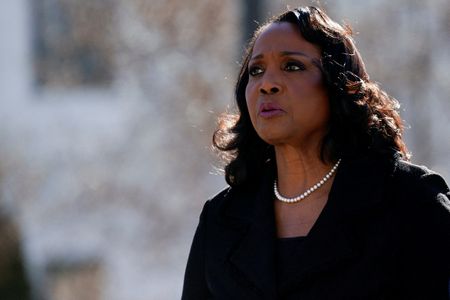
WASHINGTON, June 29 (Reuters) – The U.S. Supreme Court refused on Monday to let Donald Trump fire Federal Reserve Governor Lisa Cook as it stood firm to preserve the central bank’s cherished independence against an unprecedented challenge by the Republican president.
The court, in a 5-4 ruling, blocked Trump from removing Cook for now, providing a safeguard for the Fed specifically, even as it boosted the president’s power over government in a separate landmark ruling on Monday. In that ruling, involving Trump’s dismissal of a Federal Trade Commission member, the court expanded presidential authority to fire leaders of other U.S. agencies, overturning a precedent dating to 1935 in the process.
No other president since the central bank’s founding in 1913 had sought to oust a Fed governor. In his second term as president, Trump has tested the limits of presidential power in numerous other ways as well.
UNPROVEN ALLEGATIONS
Conservative Chief Justice John Roberts, who authored the ruling, said Trump had “failed to afford Cook the procedural protections to which she was entitled by statute. Without such protections, she could not properly dispute the charges the president laid against her.”
Trump last August cited unproven mortgage fraud allegations in trying to oust Cook, the first Black woman to serve as a Fed governor. Cook denied the allegations, calling them a pretext to remove her for monetary policy differences.
Roberts and fellow conservative Justice Brett Kavanaugh joined the court’s three liberal justices in the ruling. Conservative Justices Clarence Thomas, Samuel Alito, Neil Gorsuch and Amy Coney Barrett dissented.
The ruling definitively protects Fed officials from being fired at will by a president. Canvassing the history of the Federal Reserve System and its predecessor central banks since the founding, including the Bank of North America and the First and Second Banks of the United States, Roberts emphasized that all have featured independence from the president to shield monetary policy from political interference.
“Like the directors of its three predecessors, however, the Federal Reserve’s Governors do not serve at the president’s pleasure — they instead serve staggered 14-year terms, and may be removed only ‘for cause,'” Roberts said.
“We see no reason to leave the public in limbo, or to sow doubt as to the status of one of our nation’s (and the world’s) most important financial institutions,” Roberts added.
‘I REFUSED TO BOW’
Cook welcomed the court’s decision, saying it affirms the Fed’s obligation to make policy decisions independently, free from political interference.
“This was never about mortgage documents signed years before I became a Federal Reserve governor. It was an attempt to remove me on a manufactured pretext because I refused to bow to political pressure and continued to set interest rates based only on what would best serve the American people,” Cook said.
The court said its ruling was not deciding the validity of the factual dispute in the case, which can now return to lower courts where action has been stalled while the Supreme Court weighed in.
“It at least remains an open question what precisely happened here, and indeed whether Cook committed ‘gross negligence,’ let alone ‘deceitful and potentially criminal conduct,’ as the president’s letter alleges,” Roberts wrote, adding that Cook must be able to respond to the charges made against her.
‘APPROPRIATE ACTION’
Trump reacted to the decision in a social media post.
“The Cook Lawsuit, having to do with her suitability in sitting on the Board of the Federal Reserve, was sent back by the Supreme Court on a strictly procedural basis, we will take appropriate action immediately to make sure that someone who has committed wrongdoing will not be making vital decisions concerning the Welfare of the United States of America!” Trump wrote.
Trump’s targeting of Cook and a separate criminal investigation his administration launched in January, but later dropped, against then-Fed Chair Jerome Powell together represented the biggest challenge to the central bank’s independence since its founding.
In its separate 6-3 ruling powered by the conservative justices, the Supreme Court backed Trump’s firing of Democratic Federal Trade Commission member Rebecca Slaughter. Trump called that ruling “one of the most important ever given with respect to Presidential Powers.”
The court overturned its pivotal decision in a case called Humphrey’s Executor v. United States that rebuffed Democratic President Franklin Roosevelt’s attempt to fire an FTC member over policy differences.
Monday’s rulings follow the court’s February 20 decision in another case with major economic ramifications to strike down most of Trump’s sweeping global tariffs.
THE POWER OF THE FED
The Fed is the world’s most important central bank, an institution that determines the cost of credit for the United States and beyond and which has been in Trump’s crosshairs since his return to the presidency in January 2025.
As a Fed governor, Cook helps set U.S. monetary policy with the rest of the central bank’s seven-member board and the heads of the 12 regional Fed banks. Cook’s term in the job was due to run until 2038. She was appointed by Democratic former President Joe Biden in 2022.
May 15 was the final day of Powell’s eight years as Fed chair, though he remains a member of its Board of Governors. The U.S. Senate on May 13 voted to confirm Trump’s nominee Kevin Warsh as Powell’s successor, and he was sworn in on May 22.
When the justices in October agreed to hear the case involving Cook, they left her in the post for the time being. In contrast, they let Trump remove Slaughter last year.
THE FEDERAL RESERVE ACT
In creating the Fed in 1913, Congress passed a law called the Federal Reserve Act that included provisions to shield the central bank from political interference, requiring governors to be removed by a president only “for cause,” though the law did not define the term nor establish procedures for removal.
While Monday’s ruling did not define exactly what could constitute the “cause” under which a president could fire Cook or other board members, Roberts said that the Fed’s history and independence suggested it should be a “substantial threshold.”
“Without such constraints in place, any perceived or alleged misstep (past or present) could provide a ready pretext for a governor’s removal — a fact that he would surely know, and that would surely weigh on him as he decided what to say and how to vote,” Roberts wrote. “Nothing could be more corrosive of the independence that Congress sought to preserve.”
Trump sought to fire Cook on August 25, 2025, by posting a termination letter on social media citing the allegations disclosed by Federal Housing Finance Agency Director Bill Pulte, a Trump appointee, involving homes owned by her in Ann Arbor, Michigan, and Atlanta. Trump this month appointed Pulte as acting director of national intelligence.
Pulte wrote on social media on Monday, “As I have repeatedly said, I believe Lisa Cook will be indicted for mortgage fraud.”
In what is called a criminal referral, Pulte asked the Justice Department last year to open a criminal investigation into Cook and others over alleged mortgage fraud. There has been no indication of any such criminal investigation moving forward.
U.S. District Judge Jia Cobb in September ruled that Trump’s attempt to remove Cook without notice or a hearing likely violated her right to due process under the U.S. Constitution’s Fifth Amendment. The judge also said the allegations made against Cook likely were not a legally sufficient cause to remove her under the Federal Reserve Act as they relate to conduct that occurred before she served in the post.
The U.S. Court of Appeals for the District of Columbia Circuit declined Trump’s request to put Cobb’s order on hold.
Thomas, in a dissenting opinion, said the president can remove Cook “for any reason he wants and by any procedure he wants.” Thomas said any statute that hinders such power is unconstitutional.
Barrett faulted the ruling for “settling” the question of whether the Federal Reserve Act’s removal restriction is constitutional based on a “conclusory analogy” to predecessor central banks. Alito and Gorsuch criticized the ruling’s scope.
PUSHING THE LIMITS
Trump has heaped pressure on the central bank to cut interest rates more rapidly and more deeply than it has been willing to do as it combats persistent inflation, and lashed out repeatedly at Powell for not complying with his wishes.
Both Cook’s case and the fight over tariffs involved the legal fallout from Trump aggressively pushing the limits of presidential power since returning to office in January 2025.
Trump has also used executive authority to quickly transform policies on immigration, military service, federal employment and beyond. To date, the Supreme Court has allowed most of those policies to go ahead despite legal challenges, on a preliminary basis, though the tariffs decision was a major exception.
Trump reacted furiously to that ruling, saying he was “absolutely ashamed” of some of the justices and called the court’s Republican appointees — including two of his own — who ruled against him “fools” and “lapdogs” for Democrats.
THE POWELL INVESTIGATION
Like Cook, Powell called the administration’s action against him — an investigation involving cost overruns in a project to renovate two historical buildings at the Fed’s Washington headquarters — a pretext aimed at gaining influence over monetary policy. A judge on March 13 blocked subpoenas issued in the Powell investigation by a prosecutor appointed by Trump, agreeing with Powell that the probe was an improper attempt to intimidate the central bank into cutting interest rates. The prosecutor dropped the investigation on April 24.
Trump in January nominated Warsh, who previously served on the Fed’s Board of Governors and whose father-in-law is wealthy Trump booster Ron Lauder.
(Reporting by Andrew Chung; Additional reporting by John Kruzel, Nate Raymond, Katharine Jackson, Daphne Psaledakis and Bhargav Acharya; Editing by Will Dunham)
Brought to you by www.srnnews.com