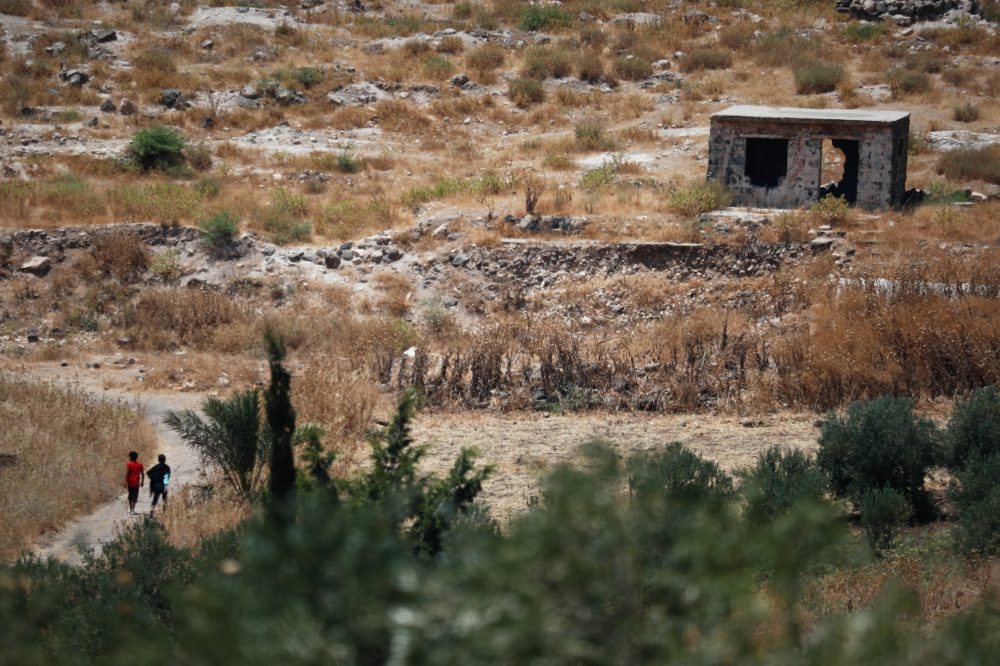
ABDIN, Syria (AP) — As Israeli troops and vehicles entered the town of Abdin in southern Syria, residents blocked the roads with rocks, and some young men and boys threw stones to push back the military patrol.
Tensions in this part of the country created by a buffer zone occupied by Israeli forces have flared into violence in recent days, leaving residents anxious that more escalation is coming. Residents of Abdin, located near a U.N.-patrolled buffer zone now controlled by Israeli troops, tried to resist against a military incursion Sunday.
Residents said Israeli troops fired warnings shots at walls and between the angry protesters, before firing artillery rounds at the village. No one was harmed in the exchange, but most residents fled, and most were still too afraid to return on Monday. Many fear that there will now be more intense incursions and raids following the skirmish.
“They come into the village regularly, every few days,” said resident Mohammad al-Hassan, standing not far from a group of children looking at an exploded shell. “They come in armored 4×4 vehicles, they roam around the village and search some houses, they knock on doors and if people don’t answer the door they break it down and enter the houses. Women and children start screaming, it’s a terrifying thing, them coming here.”
Israel seized control of a U.N.-patrolled buffer zone in southern Syria in December 2024, following the ouster of former Syrian President Bashar Assad in an insurgent offensive. Israeli officials initially described the move as temporary to protect their borders from militant groups, but more recently top Israeli officials have said they plan to occupy the buffer zone in Syria indefinitely.
The Israeli military presence in southern Syria is part of a shift to a more aggressive strategy by Israel after the deadly October 2023 Hamas-led attacks in southern Israel. The Israeli military took over large portions of Gaza as part of a broad invasion, and later seized control of chunks of Lebanon — where the Hezbollah militant group has fired missiles and drones across the border — and Syria. Israel calls these areas “buffer zones” and says they are needed to prevent future attacks by militant groups.
There have been no cross-border attacks from Syria into Israel since Assad’s ouster, except for two rockets from a little-known militant group. But Israel’s military incursions into southwestern Syrian towns have sometimes sparked resistance by residents that has spiraled into deadly clashes.
Syria’s interim president, Ahmad al-Sharaa, has called on Israel to withdraw from the area that the U.N. says is 235 square kilometers (91 square miles). The Syrian government also condemned the Israeli incursion and shelling in Abdin.
The clashes in Abdin were the second outbreak of violence in less than 24 hours. Earlier on Sunday, the Israeli military announced that it had killed armed men in southern Syria without giving details.
An Israeli military official said Monday that Israeli soldiers had killed two militants who were planning on attacking Israeli troops. The official who spoke on condition of anonymity under military briefing rules did not specify where in Syria the incident took place.
The mayor of the Syrian village of Hadar said two unknown people driving a pickup truck just south of the village were killed in an attack, and that their bodies were taken by the Israeli military.
“There was the sound of an explosion when it happened,” Imad Hassoun told The Associated Press. “They weren’t from Hadar. If they were, we would immediately know.”
Regarding the incident in Abdin, the Israeli official said armed militants opened fired against one of the Israeli military’s strongholds but nobody was harmed in the attack, without giving further details.
People in Abdin were initially hopeful that US-mediated talks between Israel and Syria in France aimed at reaching a security agreement would diffuse tensions, but the talks appear to have stalled.
Fearing the unstable security situation and struggling to cope with a lack of jobs and services, many residents who have lived in these towns are leaving elsewhere. The closest government security checkpoint to Abdin is some 10 kilometers (6 miles) away, and those who choose to stay are struggling with water and electricity shortages.
Sobhi al-Tawlbi, 66, says farmers have struggled to access their yield and sources of water.
“We need the government to support us a little so we can remain steadfast in our villages,” he said, asking for the international community to put pressure on Israel to stop its military incursions.
Syrians living in that broader border area have maintained that they are not a threat to anyone and want a stable life, following over 13 years of civil war that decimated Syria.
“Why are they bothering us? We are living here peacefully in this border area,” said al-Hassan.
___
Associated Press writers Joe Federman in Jerusalem, Kareem Chehayeb in Beirut, and Omar Albam in Damascus, Syria, contributed to this report.
Brought to you by www.srnnews.com